
Introduction
We touch our phones and tablets hundreds of times a day to scroll, type, and zoom. It feels like the glass itself is responding to our fingers, but the glass is actually just a protective layer. Underneath it lies a sophisticated electronic grid that is constantly waiting for the tiny electrical charge from your body to tell it where you are touching.
The Capacitive System
Most modern smartphones and tablets use what is called a Capacitive Touchscreen. This technology is based on the fact that the human body conducts electricity.
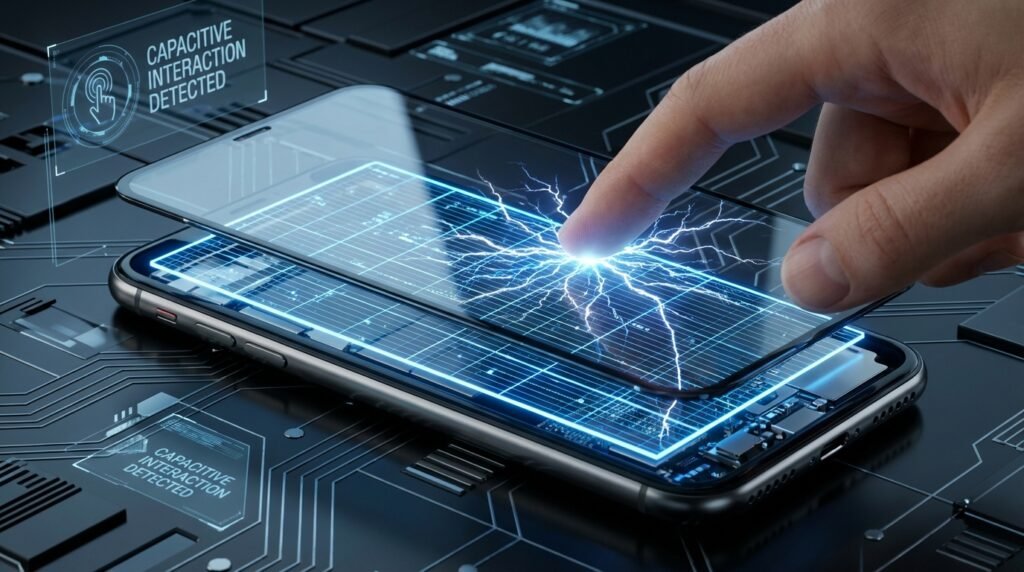
A capacitive screen is made of several layers:
- The Protective Glass: The top layer you actually touch.
- The Conductive Grid: Beneath the glass is a layer of extremely thin, transparent wires (usually made of Indium Tin Oxide) arranged in a grid of rows and columns.
- The Controller: A tiny chip that monitors the electricity in that grid.
The Electrical Interruption
When the screen is on, an electrical current flows through the grid, creating an electrostatic field. Since your finger is a conductor, touching the screen draws a tiny bit of that electricity to your fingertip.
The controller detects exactly where the “interruption” in the electrical field happened by measuring the change in capacitance at the specific intersection of the row and column. It then sends those coordinates to your phone’s processor, which translates your touch into an action, like opening an app or sending a text.
Why Your Gloves Don’t Work
Have you ever wondered why you can’t use a normal pair of winter gloves on your phone. It’s because materials like wool, leather, and plastic are “insulators”, they don’t conduct electricity. They block the electrical connection between your finger and the screen, so the grid never feels the “pull” of your touch. Special “touchscreen-compatible” gloves have conductive metal fibers sewn into the fingertips to bridge that gap.
Multi-Touch and Gestures
One of the greatest features of capacitive screens is Multi-Touch. Because the grid is so precise, the controller can track multiple points at once. This allows your phone to understand complex gestures like “pinching” to zoom or using three fingers to swipe between apps.
Conclusion
A touchscreen turns your body into a part of the device’s electrical circuit. By using a transparent grid to track the electricity in your fingertips, technology has moved from buttons and mice to a natural, direct way of interacting with the digital world.