Introduction
To see a massive airplane weighing hundreds of tons lift effortlessly into the sky is one of the greatest wonders of modern engineering. While wings provide the lift, it is the jet engine that provides the raw power needed to move the aircraft forward at incredible speeds. The secret to this power lies in a simple scientific principle: for every action, there is an equal and opposite reaction.
The “Suck, Squeeze, Bang, Blow” Cycle
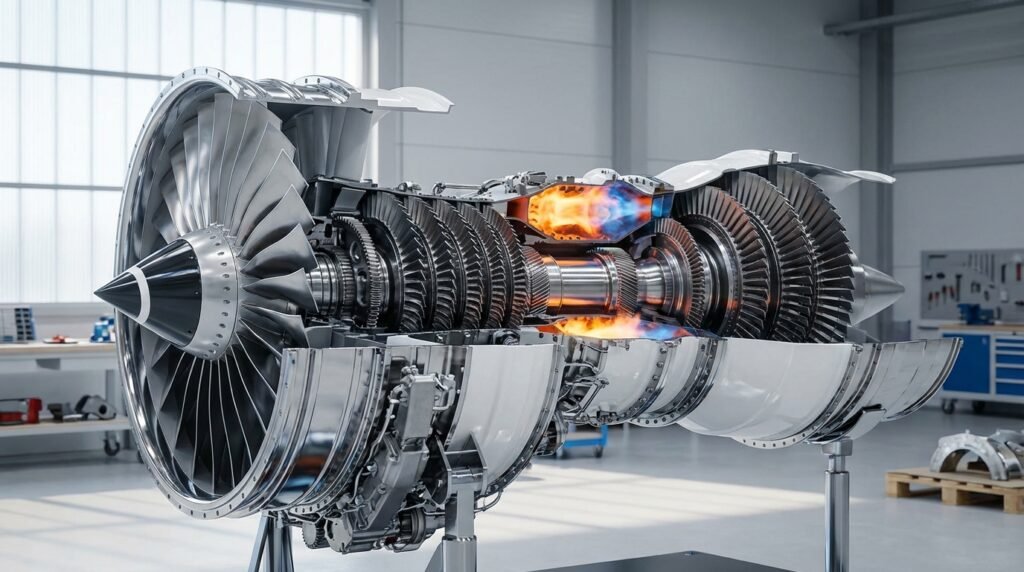
A jet engine, specifically a turbofan, is essentially a massive tube that pulls in air, speeds it up, and spits it out the back. This process happens in four distinct stages:
- Intake (Suck): A giant fan at the front of the engine sucks in massive amounts of air. Most of this air actually flows around the core of the engine (bypass air), providing the majority of the thrust that moves the plane.
- Compression (Squeeze): The air that enters the core is squeezed into a very small space by a series of spinning blades. This increases the pressure and temperature of the air, making it highly “energetic.”
- Combustion (Bang): Fuel is sprayed into the compressed air, and a spark ignites the mixture. This creates a controlled, continuous explosion that causes the air to expand violently.
- Exhaust (Blow): The hot, expanding gases blast out the back of the engine at high speed. As the gases go out the back, the engine (and the plane) is pushed forward.
The Turbine: Powering the Fan
Before the hot gases leave the engine, they pass through a set of blades called the turbine. These blades are like a windmill; the rushing air spins them around. The turbine is connected by a long shaft to the giant fan and the compressor at the front. This means the engine uses some of its own power to keep the “suck” and “squeeze” parts of the cycle going.
Why Use Jet Engines Instead of Propellers?
Propellers are efficient at lower speeds, but they struggle as an airplane gets closer to the speed of sound. Jet engines are designed to operate at high altitudes and high speeds where the air is thin, making them the perfect choice for long-distance international travel.
Conclusion
A jet engine is a masterpiece of thermodynamics and physics. By constantly pulling in air, compressing it, and exploding fuel, it creates the massive thrust required to bridge continents and connect the world.