Introduction
For decades, we have relied on burning fuels to power our homes, but the sun provides enough energy in a single hour to power the entire world for a year. The challenge has always been catching that energy. Solar panels, or photovoltaic (PV) cells, are the bridge that allows us to harvest silent, clean power directly from the sky.
The Anatomy of a Solar Cell
A solar panel is made up of many small units called solar cells, most of which are made from silicon, the same material used in computer chips. Silicon is a “semiconductor,” meaning it can conduct electricity, but only under certain conditions.
To make the cell work, engineers create two layers of silicon:
- The N-Layer (Negative): This layer has extra electrons.
- The P-Layer (Positive): This layer has “holes” or spaces for electrons to fill.
When these two layers are put together, they create an internal electric field.
The Photovoltaic Effect
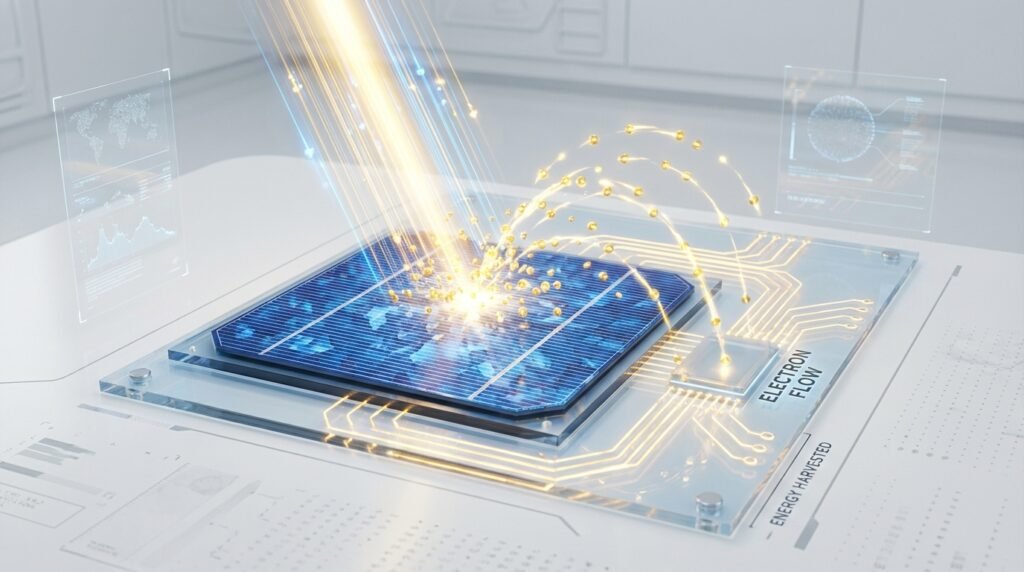
The magic happens when sunlight hits the panel. Sunlight is made of tiny packets of energy called photons.
- When a photon strikes the solar cell, its energy knocks an electron loose from the silicon atoms.
- Because of the internal electric field, these loose electrons are forced to flow in one direction.
- This flow of electrons is exactly what electricity is. By placing metal contact points on the top and bottom of the cell, we can capture that flow and send it through a wire to power your lights or charge your phone.
From DC to AC
Solar panels produce Direct Current (DC), which is the same kind of power found in a battery. However, most homes and appliances run on Alternating Current (AC). This is why every solar power system includes an inverter. The inverter takes the “raw” electricity from the panels and converts it into the “usable” electricity that flows out of your wall outlets.
Conclusion
Solar panels don’t have any moving parts, they don’t make noise, and they don’t release smoke. They simply sit on a roof and use the physics of light to provide power. As the technology becomes more efficient and affordable, the sun is set to become the most important “power plant” on the planet.