

Introduction
Artificial Intelligence, or AI, may sound like a concept from a science fiction movie, but it is already an integral part of our daily lives. From the suggested videos you see on streaming platforms to the smart replies in your email, AI is working silently in the background. At its core, AI is the science of making machines capable of performing tasks that typically require human intelligence. This guide will break down what AI is, how it “thinks,” and some of the key ways it is being used to make our lives more efficient and connected.
A Simple Definition of AI
At its most basic level, Artificial Intelligence is a broad field of computer science dedicated to creating systems that can perform tasks that require human-like intelligence. This includes things like recognizing speech, making decisions, solving problems, and learning from experience.
The goal of AI is to program computers to reason and adapt, allowing them to process information and make predictions or classifications without being explicitly programmed for every single scenario.
The Key Branches of AI
AI is a vast field with many sub-disciplines, but these are a few of the most important:
Machine Learning
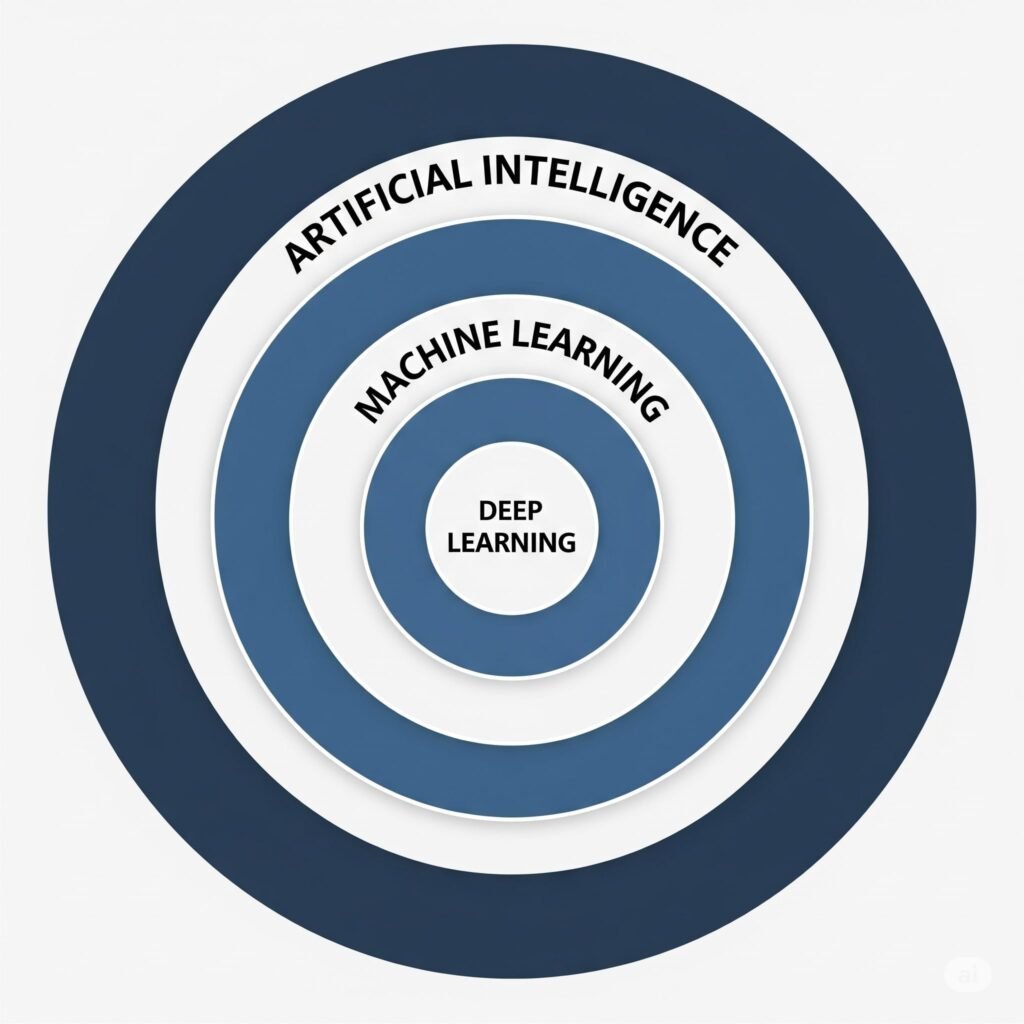
This is a subset of AI that gives computers the ability to learn from data without being explicitly programmed. Instead of following a rigid set of rules, machine learning algorithms analyze large amounts of data to find patterns and make predictions. For example, a spam filter learns to recognize spam by analyzing thousands of emails.
Deep Learning
Deep learning is an even more specialized subset of machine learning. It uses complex structures called artificial neural networks which are inspired by the human brain. These networks are highly effective at recognizing patterns in complex data, which is why they are used for things like image and speech recognition.
Natural Language Processing (NLP)
NLP is the branch of AI that enables computers to understand, interpret, and generate human language. It’s what powers virtual assistants like Siri and Alexa, and allows search engines to understand the meaning behind your queries.
How AI “Learns”: The Role of Data and Algorithms
The foundation of modern AI, particularly machine learning, is data. An AI system is given a large dataset (e.g., thousands of pictures of cats and dogs) and an algorithm. The algorithm analyzes the data, identifies patterns (e.g., dog pictures have certain ear shapes), and creates a model. Once the model is built, it can then be used to make a prediction on new, unseen data (e.g., identifying a new picture as a cat or a dog). This process is what allows AI to “learn” and improve over time.
AI in Our Daily Lives: Real-World Examples
You likely interact with AI many times a day without even realizing it.
- Search Engines: AI algorithms rank search results and provide you with relevant information.
- Social Media: AI recommends content, identifies faces in photos, and moderates content.
- Voice Assistants: Siri, Google Assistant, and Alexa use AI to understand your voice commands and provide information.
- Online Shopping: AI powers product recommendations based on your browsing and purchase history.
- Navigation Apps: AI helps to predict traffic and find the fastest routes.
Conclusion
Artificial Intelligence is not just a futuristic concept; it is a transformative technology that is here now, reshaping how we work, live, and communicate. By creating machines that can learn from data and adapt to new information, we are building systems that can solve complex problems and automate tedious tasks. As we continue to develop and apply these powerful tools, AI will play an even greater role in our world, guided by the ingenuity and wisdom of its creators.