Introduction
It feels like magic: you put a cold plate of leftovers into a box, press a few buttons, and a minute later, the food is steaming hot while the plate remains relatively cool. Unlike a traditional oven that heats the air around the food, a microwave oven uses invisible waves of energy to target the food itself.
The Magnetron: The Heart of the Machine
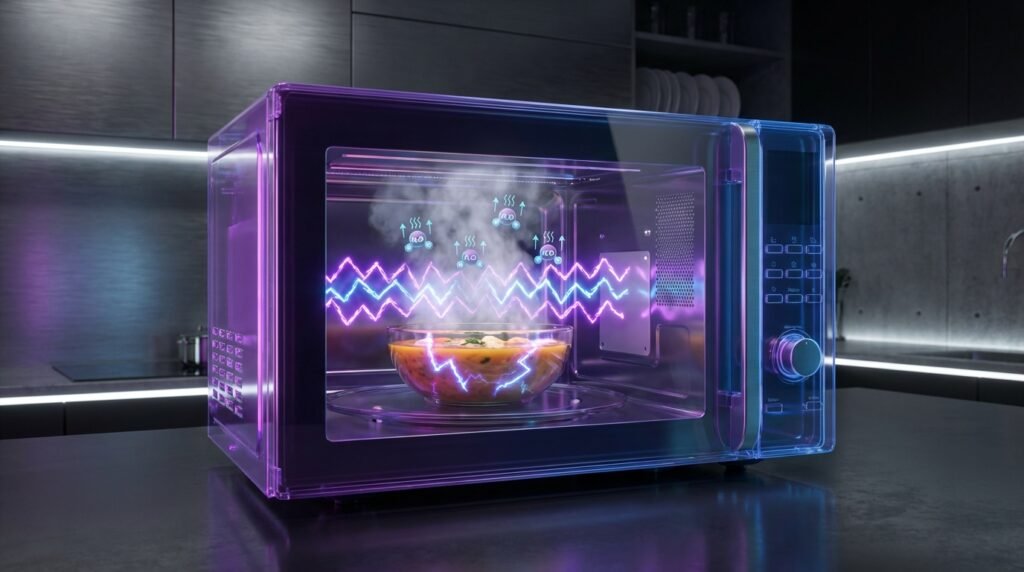
Inside every microwave is a component called a magnetron. This device takes electricity from your wall outlet and converts it into high-powered radio waves called microwaves. These waves are sent into the cooking chamber, where they bounce off the metal walls like a ball in a pinball machine.
The Science of “Water Dancing”
Microwaves have a very specific property: they are tuned to affect “polar” molecules, the most common of which is water. A water molecule has a positive charge on one end and a negative charge on the other.
- When the microwaves hit the food, they cause these water molecules to flip back and forth billions of times per second.
- This rapid flipping creates intense friction between the molecules.
- Just like rubbing your hands together creates heat, this molecular friction generates the heat that cooks your food from the inside out.
Why Do Some Spots Stay Cold?
Microwaves don’t always distribute evenly; they can create “hot spots” and “cold spots” where the waves overlap or cancel each other out. This is why most microwaves have a turntable. By rotating the food, the oven ensures that every part of your meal passes through the paths of the waves.
Why Can’t We Put Metal Inside?
Metal reflects microwaves. When you put a smooth metal bowl inside, the waves just bounce off. However, if the metal has sharp edges (like a fork), the electrons can pile up at the tips and jump through the air to the oven wall, creating “arcing” or sparks. This can damage the magnetron and even start a fire.
Conclusion
A microwave oven is a masterpiece of applied physics. By using electromagnetic waves to make water molecules “dance,” it provides a fast and efficient way to heat our food. It’s a reminder that even the most common kitchen appliances are powered by invisible, incredible science.