
Introduction
The world around us is a vibrant explosion of color, from the deep blue of the ocean to the brilliant red of a rose. But color isn’t actually “in” the objects we see. Instead, color is a sensation created in our brains. Our eyes are sophisticated light detectors that capture specific wavelengths and translate them into the beautiful palette we experience every day.
It All Starts with Light
White light, like sunlight, contains all the colors of the rainbow. When light hits an object, the object absorbs some wavelengths and reflects others. A red apple looks red because it absorbs all the colors except red, which it reflects back into your eyes.
The Back of the Eye: The Retina
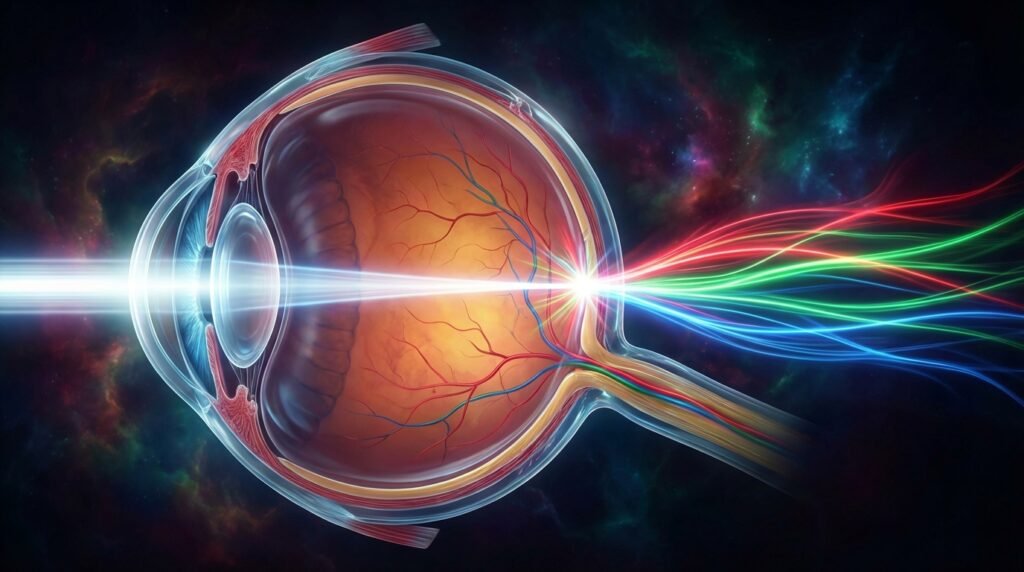
The real magic happens at the back of your eye on a thin layer of tissue called the retina. This tissue is packed with millions of light-sensitive cells called photoreceptors. There are two main types:
- Rods: These are highly sensitive to light and help us see in the dark, but they cannot detect color.
- Cones: These are our color detectors. They only work in bright light, which is why colors seem to disappear when it gets very dark.
The Three-Color System
Humans generally have three types of cones, each tuned to a different part of the light spectrum:
- S-Cones: Sensitive to “Short” wavelengths (Blue).
- M-Cones: Sensitive to “Medium” wavelengths (Green).
- L-Cones: Sensitive to “Long” wavelengths (Red).
When you look at something purple, both your blue cones and your red cones are stimulated. Your brain receives these combined signals and interprets them as “purple.” This is very similar to how a computer screen or a TV uses red, green, and blue pixels to create every color you see.
The Brain’s Interpretation
The eye gathers the data, but the brain is the artist. The electrical signals travel from the retina through the optic nerve to the visual cortex. Here, your brain instantly processes the data, adjusting for shadows and lighting conditions to tell you exactly what color you are looking at.
Conclusion
Seeing color is a perfect partnership between physics and biology. By catching reflected light and sorting it through specialized cells, our eyes and brains work together to paint the world in millions of different shades. It is one of the most complex and beautiful processes in the human body.