Introduction
Whether it is the tiny cell in your watch, the battery in your smartphone, or the massive pack in an electric car, batteries are the silent heroes of modern life. They allow us to carry electricity in our pockets. But a battery doesn’t actually store “electricity” like water in a bottle, it stores chemical energy that it converts into electrical energy on demand.
The Three Main Parts
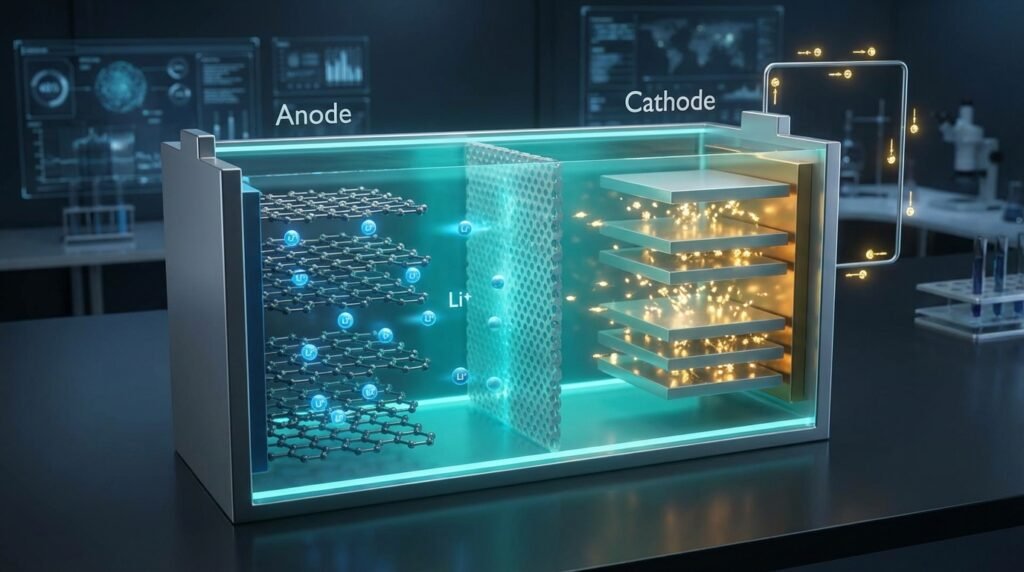
Every battery, regardless of its size, is made up of three essential components:
- The Anode (Negative side): This side has an abundance of electrons waiting to leave.
- The Cathode (Positive side): This side wants to receive electrons.
- The Electrolyte: This is a chemical medium (liquid or gel) that sits between the two sides. It acts as a gatekeeper, allowing ions to move through it while forcing electrons to take a different path.
The Chemical Reaction
When you connect a battery to a device (like a flashlight), a chemical reaction begins.
- The Anode releases electrons.
- These electrons want to get to the Cathode, but the Electrolyte won’t let them pass directly through the middle.
- Instead, the electrons are forced to flow through your device’s wires to reach the other side. This flow of moving electrons is exactly what we call electricity.
Rechargeable vs. Single-Use
In a standard alkaline battery (like the ones in a TV remote), the chemical reaction only goes one way. Once the chemicals are used up, the battery is “dead.” However, in a Lithium-Ion battery (like in your phone), the reaction is reversible. When you plug your phone into the wall, the charger forces the electrons and ions back to their original positions at the Anode, “resetting” the battery so it can provide power all over again.
Conclusion
A battery is essentially a controlled chemical reaction in a box. By using chemistry to push electrons through a circuit, batteries give us the freedom to use technology anywhere. As we develop better materials for anodes and cathodes, batteries are becoming smaller, safer, and more powerful than ever before.